
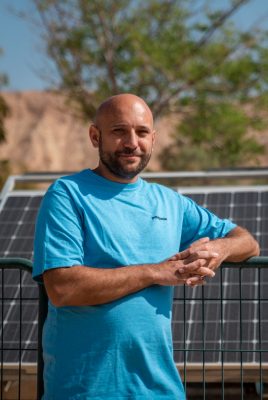
 This spring, I had the opportunity to teach the Alternative Energy Science course at the Arava Institute together with Dr. Tareq Abu Hamed. While the course introduced students to renewable energy technologies such as solar energy, wind power, biomass, hydrogen, energy storage, and hybrid systems, one of the most important lessons that emerged throughout the semester was that energy is about much more than technology.
Energy shapes how societies function. It influences economic development, the environment, food production, water security, public health, and even national security. As a result, our goal was not only to teach how different energy systems work, but also to encourage students to think critically about the role of energy in addressing some of today’s pressing global challenges.
One of the most engaging aspects of the course was our weekly energy news discussion. Each week, students selected and presented recent developments from around the world, ranging from renewable energy investments and technological innovations to electricity shortages, energy security concerns, and climate-related challenges. These discussions helped bridge the gap between theory and practice, allowing students to connect classroom concepts with real-world events unfolding in different regions of the world.
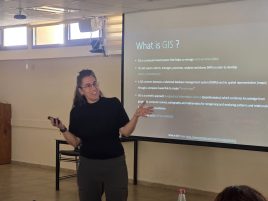 The course also benefited from several guest lectures that introduced students to interdisciplinary perspectives on energy systems. Dr. Shlomo Wald presented the Water-Energy-Food-Ecosystems (WEFE) Nexus approach and demonstrated how integrated planning can support sustainable development and regional cooperation in the Jordan Valley. Dr. Melinda Zsolt explored the relationship between energy democracy, energy security, and defence, highlighting how energy systems are increasingly connected to resilience and geopolitical stability. Dr. Aviva Peeters introduced students to Geographic Information Systems (GIS) and Multi-Criteria Decision Analysis, demonstrating how spatial tools can support environmental and energy planning.
The diversity and creativity of the students’ final projects reflected the broad scope of the course. Rather than focusing solely on technological solutions, students examined how energy intersects with environmental, social, and economic challenges.
One project explored how traditional desert housing techniques and low-tech solutions can help communities adapt to extreme heat and environmental conditions. Another investigated whether piezoelectric technologies could capture energy from human movement in urban spaces and contribute to future renewable energy systems. Students also examined solar energy adoption in Johannesburg as a response to persistent electricity shortages, the potential of agrivoltaics in Israel to combine food production with renewable energy generation, and innovative energy storage solutions for off-grid Bedouin communities.
Several projects demonstrated a particularly strong systems-thinking approach. One student developed a decentralized solar energy concept for an informal settlement in Zimbabwe using the WEFE Nexus framework, examining how renewable energy could simultaneously improve water access, livelihoods, and community resilience. Others explored how energy solutions can support both environmental sustainability and social development in different regional contexts.
As a lecturer, one of the most rewarding aspects of the course was seeing students move beyond viewing energy simply as electricity generation. Throughout the semester, they increasingly recognized energy as a fundamental component of broader social-ecological systems. Their questions, discussions, and projects highlighted the importance of interdisciplinary thinking and the need to consider not only technological feasibility but also social acceptance, governance, equity, and environmental impacts.
At the Arava Institute, education is not only about transferring knowledge. It is about creating opportunities for students to engage with complex challenges, explore diverse perspectives, and develop practical solutions for a rapidly changing world. The final projects presented at the end of the semester demonstrated exactly that spirit.
In a world facing climate change, growing energy demand, and increasing uncertainty, educating the next generation of leaders requires more than teaching technologies. It requires fostering systems thinking, creativity, and a deeper understanding of how energy connects people, communities, and ecosystems. This semester’s students reminded me that the future of energy will ultimately be shaped not only by new technologies, but also by the people who choose how to use them.
Submitted by Dr. József Kádár